



Saudi IT Companies in 2026: Market Size & Demand Segments.
2026 market intelligence on Saudi IT companies: market size, demand, vendor landscape, and entry constraints for foreign firms.

Saudi IT Companies in 2026: Market Size & Demand Segments.
Saudi IT Companies in 2026: Market Size, Demand Segments, and the Vendor Map
Key Findings
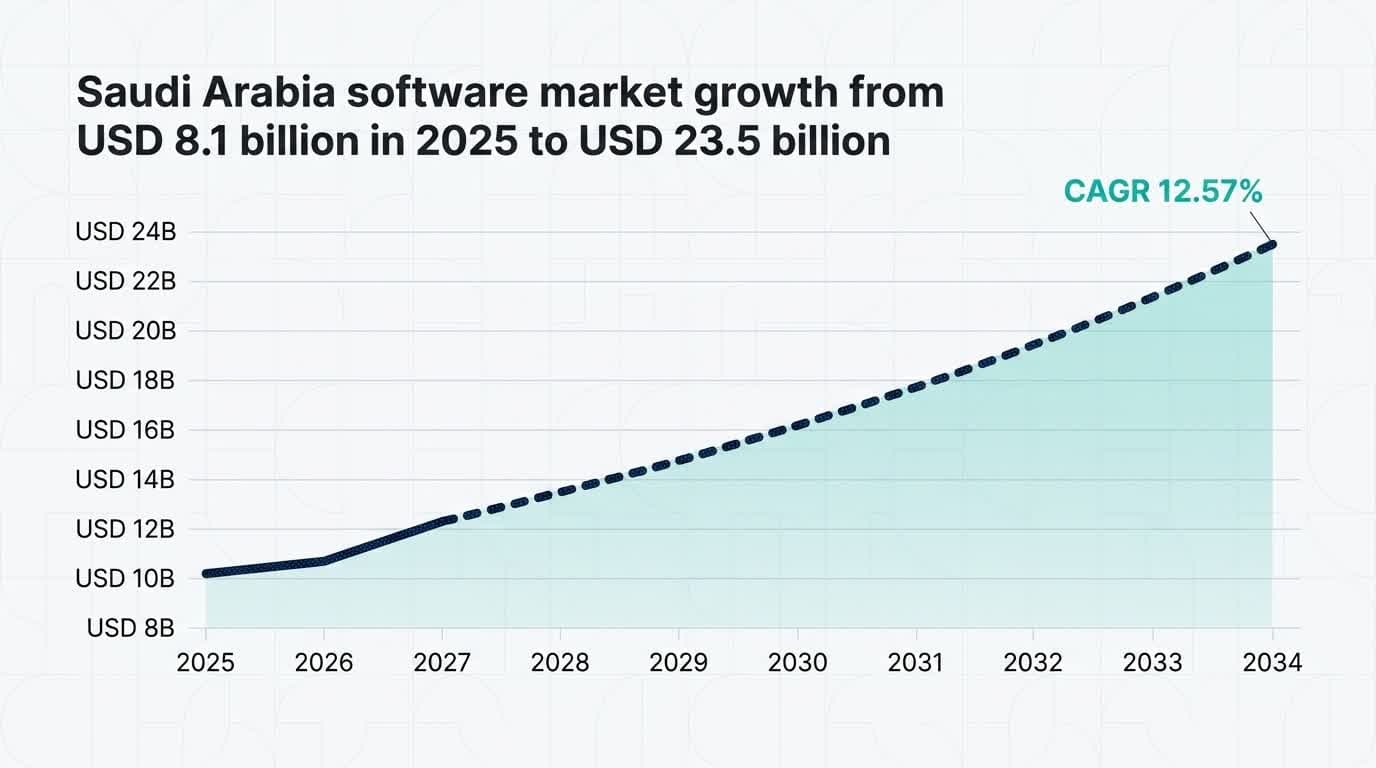
- The Saudi software market has been on a sustained expansion path. Valued at USD 8.1 billion in 2025, it is hoped to reach USD 23.5 billion by 2034 at a compound annual growth rate of 12.57 percent, outpacing broader IT infrastructure growth.
- Saudisation operates as the primary structural constraint for foreign market entrants. Under the Nitaqat system, engineering and technology firms must achieve a 30 percent Saudi-national staffing ratio to secure necessary business visas.
- Low Competitive Intensity in App Development: The app development segment exhibits the lowest competitive intensity index in the dataset at 8.9, with the discovery layer currently dominated by offshore agencies hosted on aggregator platforms rather than local content authority.
- Liberalised Foreign Ownership: Regulatory reforms now allow foreign technology founders to achieve 100% ownership of their Saudi entities through the Ministry of Investment (MISA), bypassing the historical requirement for a local partner or sponsor.
Empty aggregator lists cannot satisfy five thousand monthly buyers searching for Saudi software partners. The actual software market in Saudi Arabia is hidden behind complex regulatory gates, talent quotas, and regional geography. Vision 2030 has directed unprecedented public spending into software, AI, and digital infrastructure across the Kingdom of Saudi Arabia.
The Saudi software market, valued at USD 8.1 billion in 2025, is expanding toward USD 23.5 billion by 2034 at a compound annual growth rate of 12.57 percent. This structural shift, documented across multiple analyst sources, represents a highly consequential market opportunity in the Gulf region for technical decision-makers evaluating entry or expansion. The market is generating procurement activity faster than the local content ecosystem can process and interpret it.
Across 202 unique demand segments, 43,850 monthly buyer intent signals touch some aspect of software procurement in Saudi Arabia. The digital infrastructure serving that intent remains conspicuously thin on substantive market intelligence. Directory platforms dominate the discovery layer, monetising buyer queries without serving the buyer's need for evidence-based market analysis.
The regulatory architecture for foreign investment has shifted materially in recent years. Achieving 100 percent foreign ownership of Saudi entities is now possible through the Ministry of Investment, removing the structural barrier that historically governed Gulf Cooperation Council market entry for international technology firms.
The talent constraint remains a real and structural consideration for entering companies. Nitaqat Saudisation requirements create mandatory workforce composition obligations that must be designed into commercial architecture from the earliest planning stages. However, this constraint is entirely navigable, and the market opportunity is not conditional on navigating it perfectly.
What the demand analysis reveals is a market that is large, growing, and underserved by the analytical content that should support it. This document addresses what the evidence actually shows about where the demand is concentrated, how the competitive landscape is structured, and how a foreign software company should plan to enter or expand in the Kingdom of Saudi Arabia during 2026.
Market size: what 43,850 monthly buyer intent signals actually measures
Five thousand buyers search for Saudi IT vendors every month, yet they find only empty aggregator lists. The real software market in Saudi Arabia is hidden behind regulatory gates, talent quotas, and regional geography. This digital intent represents a profound migration from traditional offline tenders to modern digital discovery phases.
Across 202 unique demand segments, 43,850 monthly buyer intent signals touch some aspect of software procurement in Saudi Arabia [1]. This volume represents active organisations investigating concrete software-related spend decisions rather than theoretical interest.
These search metrics serve as an empirical proxy for economic activity, reflecting how procurement teams map capabilities before engaging vendors. The scale of these queries indicates that relationship-driven offline tenders are rapidly being replaced by structured online discovery.
Independent analyst firms provide highly comparable market-size estimates that confirm this rapid commercial expansion. For instance, IMARC Group values the Saudi Arabia software market at USD 8.1 billion in 2025, projecting expansion to USD 23.5 billion by 2034 at a compound annual growth rate of 12.57 percent [1].
Grand View Research offers a broadly consistent reading, placing 2024 software-sector revenue at USD 10,071.8 million with a trajectory toward USD 22,748.2 million by 2030 [2]. The slight variance between these models reflects different methodological boundaries regarding what constitutes the software segment. Nonetheless, the directional agreement remains clear, pointing to a sustained expansion path through the end of this decade.
Within the broader software segment, sub-sector differentiation reveals distinct growth profiles. Mobile app development, valued at USD 2.2 billion in 2025, is forecast to reach USD 5.2 billion by 2033 at a compound annual growth rate of 11.20 percent [1]. Enterprise software commands a larger current base at USD 3.53 billion in 2025, projected to grow to USD 10.38 billion by 2033 [1].
Both sub-segments are outpacing the overall IT market growth rate, which Technavio models at 7.0 percent compound annual growth rate for the 2026 to 2030 period [3]. Software is expanding faster than the physical IT infrastructure that hosts it.
Labour-market realities add a critical operational layer that macro-economic figures alone cannot capture. Software engineers in Saudi Arabia operate across a wide compensation band, with monthly salaries ranging from SAR 15,000 to SAR 40,000 depending on seniority and employer type. International firms and government-linked contractors occupy the upper end of this range, while local small and medium enterprises typically offer less.
For a mid-level developer earning between SAR 13,000 and SAR 18,000 per month, the cost of living in Riyadh consumes a substantial share of net income. Typical accommodation costs alone absorb 40 to 50 percent of these monthly earnings. This structural pressure on the supply side of the domestic labour market directly influences project-based pricing and talent availability.
The state-led digital transformation agenda under Vision 2030 introduces an additional layer of demand. This strategy is coordinated through the Saudi Data and AI Authority (SDAIA) and the Ministry of Communications and Information Technology (MCIT), creating regulatory incentives that accelerate software procurement. Consequently, software vendors benefit from a policy architecture that ties digital adoption directly to government department performance metrics and enterprise compliance requirements.
The web and website development demand segment: the largest segment, mid-market saturation, and the custom-versus-WordPress split
The web and website development demand segment dominates the Saudi software market map by volume, with approximately 12,000 monthly buyer intent signals tracked across 42 demand segments. This volume represents a reliable proxy for the breadth of regional buyer intent, sitting at a competitive intensity index of 27.2. The segment encompasses a wide spectrum of requirements, ranging from basic corporate web presences to complex enterprise-grade e-commerce platforms.
This high volume of search queries indicates a broader structural shift where traditional B2B procurement processes are migrating from offline tenders to digital discovery phases. Buyers increasingly use search tools to pre-qualify vendors long before issuing formal requests for proposals. Consequently, digital footprint visibility acts as a primary filter for organisations seeking to enter the Saudi vendor ecosystem.
The competitive landscape composition and what it reveals
The primary market positions for web development queries in Saudi Arabia include firms such as Magneto IT, StandardTouch, and Halo Lab. This competitive layer also features regional boutique providers like Element8, Edirect, and Bytes Future. This diverse mix of global agencies and local specialists indicates a market that has not yet consolidated around a single dominant delivery model.
The coexistence of custom software developers and template-driven content management system (CMS) shops reveals a fundamental division in buyer maturity. While some buyers require complete architectural control and bespoke database structures, others prioritise rapid deployment at a lower initial cost. The competitive landscape reflects this split, with neither approach holding a clear majority across the search space.
The choice between these paths involves significant technical trade-offs, particularly regarding security and database performance. Standard WordPress deployments often struggle with database scaling and security vulnerabilities in highly regulated Saudi sectors. Conversely, bespoke frameworks built on Laravel or Node.js allow developers to implement clean, microservices-ready architectures that scale predictably under heavy enterprise loads.
Internationalisation presents another critical engineering challenge, specifically regarding right-to-left (RTL) rendering for Arabic-first user experiences. While template engines often apply basic CSS overrides for RTL layouts, bespoke codebases allow for native logical properties that prevent layout shifts and rendering latency. Implementing caching layers like Redis or Varnish also becomes much simpler when decoupled from heavy monolithic CMS databases.
Agencies capable of explaining these complex technical trade-offs, rather than offering generic services, secure a distinct advantage. Buyers are increasingly moving past surface-level marketing to evaluate local providers with verified execution capabilities in Riyadh and Jeddah.
City-level demand patterns
Location-specific search patterns introduce another layer of detail to the market map. Search queries such as "website design Riyadh" and "website design company in Jeddah" each attract approximately 500 monthly buyer intent signals. In a market of over 36 million residents, this localised volume indicates that buyers seek partner firms with clear regional context rather than abstract offshore providers.
This geographic specificity directly influences how software partners must position their capabilities. Having a physical local presence or presenting regional case studies acts as a critical trust signal during technical procurement evaluations. Buyers in Riyadh frequently focus on government-aligned standards, while Jeddah-based firms often operate with commercial speed and consumer-facing agility.
The search term "IT Companies in Jeddah" follows a similar pattern, linking specific web design queries with broader IT services. This crossover indicates that coastal buyers are conducting category-level research to qualify full-service tech partners rather than transactional web agencies. The data suggests a substantial portion of the market remains in the diagnostic phase, actively comparing end-to-end capabilities before committing to contract signing.
The talent supply chain and what it means for buyers
The dynamics of the web development segment are deeply tied to the underlying technical talent supply chain. To navigate local talent shortages, many Saudi companies rely on remote engineers based in India, Pakistan, and Eastern Europe. While this global sourcing strategy reduces direct development costs, it introduces communication overhead and critical timezone alignment challenges.
Large-scale enterprise projects are frequently managed by global system integrators such as Wipro, TCS, and Infosys. These massive organisations deploy their own offshore teams, creating multiple administrative layers between the client and the engineers writing the code. For buyers, these multi-tiered delivery models often result in lost agility, misaligned requirements, and unexpected delivery delays.
Domestic compensation trends reflect this structural talent pressure within the local market. Mid-level software engineers in the Saudi private sector typically command monthly salaries between USD 2,500 and 3,500, with public sector entities offering substantially higher packages. This steep competition for skilled local talent drives up development costs for onshore agencies, pushing many buyers back toward hybrid or offshore delivery frameworks.
Regional development studios confirm that clients frequently seek new partners after suffering failed deliveries with low-cost offshore agencies. This history of compromised projects has created a highly cautious procurement environment where buyers prioritise technical due diligence over initial pricing. Buyers now demand transparent progress tracking, clean code repositories, and direct access to the actual development team.
While the web development space captures the highest overall search volume, it remains a saturated and highly competitive segment. By contrast, the mobile application development landscape presents a different set of dynamics, characterised by lower direct competition and distinct offshore dependencies. Examining these mobile-specific patterns reveals a clear pathway for partners capable of delivering high-performance native and cross-platform mobile solutions.
The app development demand segment: lowest competitive intensity in the dataset, and the offshore-agency reality
The app development demand segment registers a competitive intensity index of 8.9 across 27 demand segments, representing the lowest average difficulty recorded in the region. This low index is not a signal for market entrants to relax. Instead, it indicates a structurally segmented market where offshore providers, operating from outside the Kingdom, absorb the majority of visible search demand.
The primary search terms driving this segment are 'app development company Saudi Arabia' with 500 monthly buyer intent signals and a competitive intensity of 14, alongside 'app development Saudi Arabia' and 'mobile app development Saudi Arabia', which both register 500 monthly signals and an intensity of 9. Whilst the overall segment average sits at 8.9 across 27 related terms, including iOS, Android, and Flutter variants, this figure conceals a stark split. The generic, high-volume head terms carry competitive intensity scores that place them firmly in the medium-to-high difficulty range.
By contrast, long-tail variants skew lower, offering potential areas where a focused operator might secure defensible positioning. Specific localised terms such as 'app development company in Riyadh' represent highly accessible entry points for digital agencies. This long-tail space allows newer entrants to bypass the heavily contested generic keywords.
Total demand volume across this segment sits at approximately 7,650 buyer intent signals per month, representing a meaningful yet modest audience compared to the broader enterprise software space. This indicates that while mobile application development is a highly viable sector, it is not the largest or most contested segment in the Saudi digital landscape.
The anatomical composition of the competitive landscape is far more instructive than raw search volume. Dominant positions for primary app development terms are occupied by offshore providers, including Appinventiv, Apptunix, DXB Apps, TekRevol, Suffescom, and Esferasoft, who leverage aggregator platforms like Clutch and Sortlist to capture regional visibility. These intermediary platforms host developer profiles and standardise the review process, presenting global delivery models directly to Saudi procurers.
When local organisations seek a mobile application vendor, their primary objective is finding an immediate technical solution rather than restricting search parameters to domestic boundaries. Aggregator networks have positioned themselves as the default answer, succeeding because they invest heavily in discoverability and structured trust metrics that local vendors rarely match.
This structural gap makes it challenging for domestic developers to intercept early-stage buyer journeys. Because of this noise, buyers weighing their development options should carefully consider how to evaluate custom software development services before committing capital to any partner.
Qualitative evidence from the domestic market reinforces this dynamic. Local technology leaders note that clients consistently seek new engagements after suffering delivery failures with previous development partners. This creates a critical procurement signal, as prior negative experiences mean trust and delivery capability have become the primary selection criteria, ahead of raw pricing considerations.
Industry discussions highlight that many companies within the Kingdom actively hire remote development talent across India, Pakistan, and Eastern Europe to scale capacity rapidly. Although time-zone differences and code quality control introduce friction, structured offshore agencies offset these challenges through formalised project management offices and strict delivery governance.
Furthermore, domestic recruitment remains costly, with salary surveys showing mid-level engineers in private Saudi firms earning between USD 2,500 and USD 3,500 monthly, whilst government-backed entities offer even higher packages. These payroll benchmarks indicate that local engineering overheads are substantial, providing a compelling economic rationale for offshore and nearshore hybrid models.
Empirical research indicates that Agile adoption within local software small and medium-sized enterprises remains in its foundational phases, despite substantial public investment in technology frameworks. Success is heavily influenced by human factors, customer collaboration, team capability, and organisational alignment, rather than purely technical challenges. Consequently, buyers engaging domestic suppliers must navigate varying levels of process maturity, which can introduce delivery risks to highly complex or bespoke mobile builds.
Conversely, offshore providers operate within mature technological ecosystems where agile methodologies and rapid iteration are thoroughly normalised. Their established delivery frameworks, structured communication channels, and international reference lists serve as crucial proxies for quality assurance. Aggregator networks amplify these advantages by organising peer reviews and historical performance data into standardised formats, offering a structured due-diligence shortcut that many local operators are yet to replicate.
While the app development segment highlights a clear tilt towards offshore and nearshore structures, the vendor selection challenge extends far deeper than a single technology category. The subsequent analysis explores how discovery mechanics, vendor evaluation methods, and regional systems integrators shape broader procurement behaviour across the Kingdom.
The vendor landscape: how Saudi IT companies are discovered and evaluated
The market positions for Saudi IT companies and software vendors in Saudi Arabia are rarely defined by the independent digital portals of software houses in Riyadh. Instead, they are dominated by third-party aggregators. Clutch, Sortlist, DesignRush, GoodFirms, and ITFirms occupy the primary positions in the vendor-discovery market structure.
The companies listed on these portals are real operational entities. However, the information architecture that surfaces them is not a neutral directory. It functions as a commercial marketplace where vendors pay for visibility, leaving buyers to navigate the system without an obvious signal that the rankings reflect paid placements rather than editorial curation.
The scale of the market this arrangement addresses is substantial. Two distinct demand segments converge in this discovery space.
The general IT companies segment commands an estimated 7,550 monthly buyer intent signals at a competitive intensity of 47.1. Meanwhile, the software development segment attracts 1,350 monthly buyer intent signals at a competitive intensity of 36.2.
Combined, these segments represent approximately 9,100 monthly buyer intent signals at an average competitive intensity of 41.7. This volume represents the total addressable demand at the critical vendor-discovery moment. What occurs at this juncture is shaped less by the technical capability of Saudi software firms and more by the commercial economics of aggregator platforms.
Why aggregators control the market structure
Aggregator platforms occupy the discovery market structure for a clear structural reason. They resolve an information asymmetry problem that most corporate buyers struggle to address independently.
Selecting a software vendor in a market where technical assessment is complex, past performance is difficult to verify, and the consequences of delivery failure are high creates a rational demand for third-party validation. Aggregators provide this in the form of reviews, portfolios, and ranking frameworks.
While these assets present themselves as objective, independent assessments, they frequently operate as commercial listings. The underlying aggregator model generates revenue from vendor subscriptions rather than buyer fees.
Consequently, the platform's financial incentives run alongside the buyer's informational needs without necessarily aligning with them. A vendor with a strong payment history and a complete profile often receives prominent placement regardless of historical review quality or project outcomes.
The distinction between a paid listing and an editorial recommendation is rarely explicit to the search user, as aggregator pages are seldom labelled as advertising. These profiles rely heavily on client-submitted reviews, which allows agencies with dedicated profile-management campaigns to rank highly regardless of their technical complexity or industry suitability.
The buyer journey through aggregators
Direct evidence of how Saudi buyers navigate vendor selection appears in community discussions. In threads focused on how to choose a software company in Saudi Arabia, respondents frequently distinguish between local Saudi firms and international companies operating in the Kingdom.
The pattern in these user discussions remains consistent. International firms are generally perceived as delivering more reliable results, showcasing deeper technical expertise and fewer operational communication issues.
Conversely, local companies are sometimes described as struggling with quality consistency and professional management. In these forums, communication breakdowns appear as a recurring challenge for buyers.
This market perception is grounded in structural realities. International software firms operating in Saudi Arabia typically deploy standardised global delivery frameworks, experienced expatriate project managers, and mature quality assurance processes.
In contrast, local firms often operate with smaller technical teams, experience higher staff turnover, and have a more limited capacity to absorb scope changes without delivery delays. The informal consensus within the buyer community is therefore grounded in collective experience rather than marketing claims.
The system integrator layer
Above the boutique or specialised vendor level, large system integrators occupy a distinct tier in the Saudi IT market. Firms such as Wipro, TCS, and Infosys operate at immense scale within the Kingdom.
These entities typically bring their own external teams for large-scale enterprise deployments rather than being engaged as discrete local software developers. This operational model allows Saudi organisations to bypass the complexities of direct expatriate recruitment, visa processing delays, and localised salary competition.
For enterprise buyers, engaging a system integrator represents a different risk calculus. The buyer assesses the integrator's global track record and multi-country delivery capability rather than the credentials of individual programmers.
This shifts the due-diligence inquiry from technical capability to long-term reliability at scale. Because the answers to these questions are easier to verify through enterprise reference clients, large integrators remain highly favoured in government and corporate procurement processes.
Local firms versus international agencies
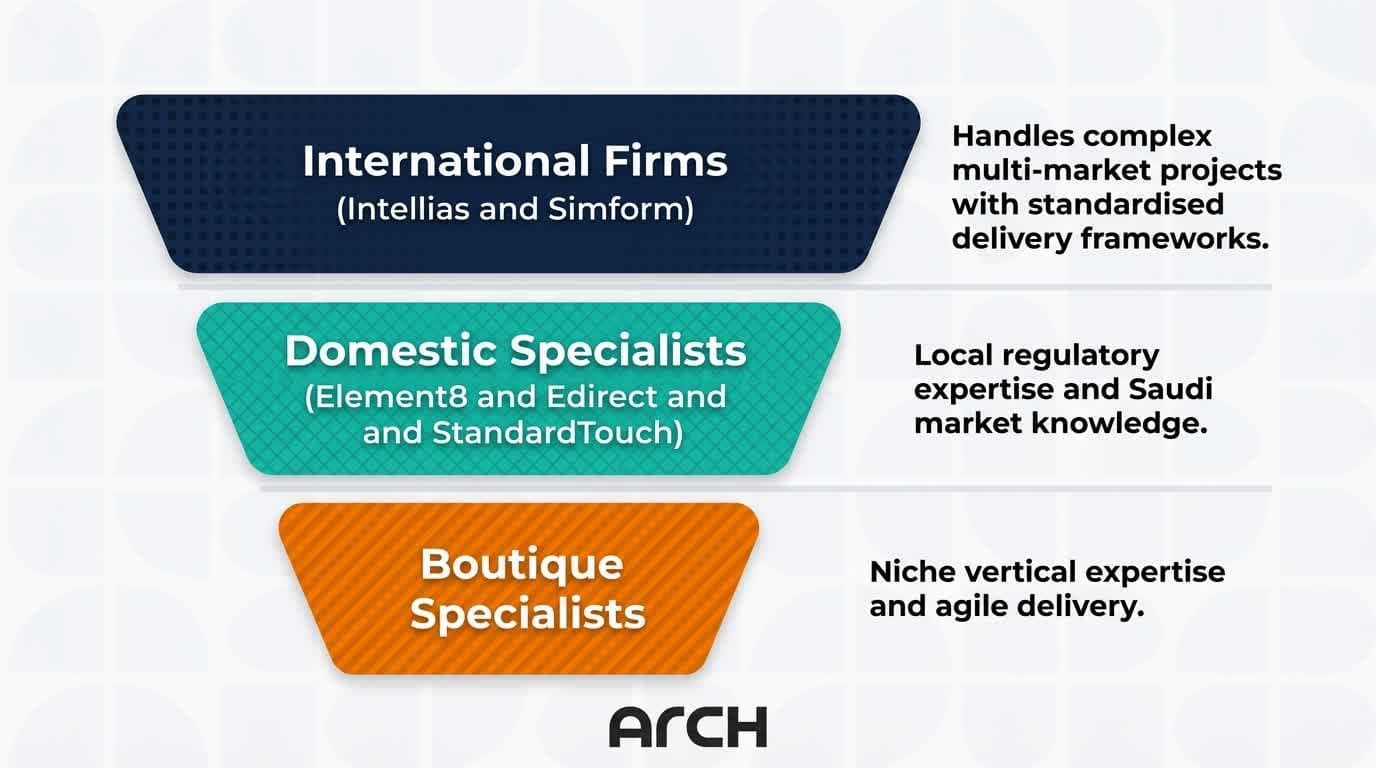
The Saudi software market is served by three primary tiers: domestic specialist firms, international agencies operating in-country or remotely, and the aggregator platforms that sit between buyer and provider. Each tier carries distinct credibility signals, pricing models, and risk profiles. Buyers who understand these divisions are better equipped to avoid common sourcing mistakes.
The domestic segment includes firms such as Element8, Edirect, and StandardTouch. These providers operate primarily within the Kingdom and possess deep experience with the local regulatory and contractual environment.
Academic and industry studies of national ERP vendors in government organisations indicate that domestic firms bring specific advantages in navigating public-sector procurement norms. However, the same research identifies persistent gaps in technical depth and project management maturity compared with international counterparts.
These findings align with broader market feedback, which notes that local Saudi firms can struggle with delivery consistency. Furthermore, client stakeholders frequently cite communication issues as a primary friction point when working with domestic IT vendors.
International agencies offer a different value proposition. Firms like Intellias, Simform, and Suffescom operate across multiple markets and deploy standardised delivery frameworks, typically managed from nearshore or offshore development centres.
Market evidence suggests that these international firms tend to deliver more reliable results on complex or multi-market projects than domestic-only vendors. The major technology and telecommunications sectors reinforce this delivery pattern.
For instance, Aramco maintains massive internal IT operations to secure its infrastructure. At the same time, STC and its subsidiaries function as massive system integrators that consume specialised services from both domestic and international vendors.
How to evaluate vendors
The underlying demand for software vendors in Saudi Arabia is directly anchored to rapid digital infrastructure expansion. Data centre capacity in the Kingdom is on a trajectory to expand at 29 percent annually through 2030, heavily driven by Vision 2030 initiatives.
Furthermore, Saudi Arabia achieved a United Nations E-Government Development Index score of 0.9602 in 2024, indicating a high level of public-sector digital maturity. These figures describe the actual structural conditions that generate ongoing demand for software vendors across government, enterprise, and SME segments.
Independent founder discussions add an essential layer of practical due diligence that aggregator platforms cannot easily replicate. Buyers who have navigated the market share significant concerns about body-shop operations. These are vendors that assemble a team for a specific project but substitute junior resources once senior staff migrate to other clients.
The signals most commonly cited as reliable during due diligence include several critical structural factors. Buyers are encouraged to audit these criteria closely before signing any contract:
- The proportion of in-house engineers versus subcontracted labour
- The vendor's willingness to share direct client references from similar-scale projects
- Evidence of a structured, audited delivery methodology
- The depth of domain experience in the buyer's specific industry sector
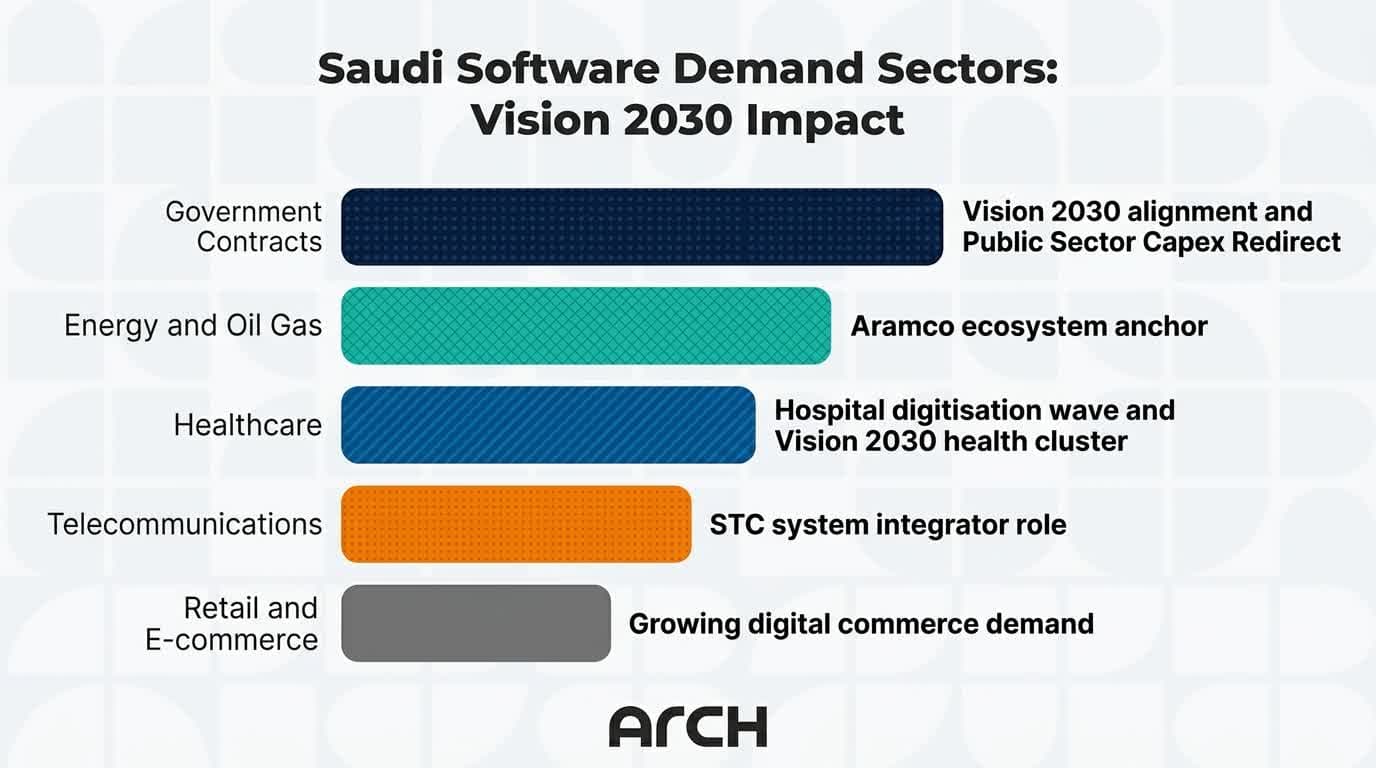
The concentration of the Saudi market around government contracts and large corporate IT departments shapes the vendor landscape in ways that amplify these distinctions. Vendors who have established government project references and relationships with entities such as Aramco, STC, or SABIC carry credentials that are difficult for newer entrants to replicate.
For buyers evaluating vendors through the aggregator layer, the discovery market structure is merely a starting point rather than a final shortlist. The evaluation must extend to delivery track records in comparable Saudi contexts, explicit staff continuity commitments, and clarity on whether the vendor operates as a principal or an intermediary.
Aggregator pages answer who is available, not who is appropriate for a highly specific technical context. That fundamental distinction is precisely where thorough buyer due diligence begins.
Engagement models available in the Saudi market
Buyers who have progressed beyond vendor discovery to project scoping encounter a secondary structural question regarding engagement models. The Saudi market supports four primary structures, each with distinct implications for cost certainty, flexibility, and delivery risk.
A Fixed Price engagement sets a defined budget for a defined scope, transferring scope management risk to the vendor. This model suits projects with stable, well-documented requirements where the buyer has high confidence in their specification. It is the least flexible model for projects where requirements evolve during development, as any scope change generates a formal change order with associated cost and timeline impact.
A Time and Material engagement structures cost against actual hours consumed, with the buyer paying for flexibility and the vendor incentivised to maintain efficient delivery. This model suits projects at the early scoping stage where requirements are not fully defined, or where the buyer's internal team is still evaluating the product direction. It requires stronger buyer-side project management than Fixed Price, but it accommodates scope evolution without the friction of formal change orders.
A Dedicated Team engagement places one or more developers, or a complete development team, under the client's direction on an ongoing basis. This model is suited to product development programmes, large-scale projects with extended timelines, or companies building ongoing in-Kingdom technical capability. The client directs the work directly and controls the allocation of resources.
Team continuity becomes a key evaluation criterion under this model. Vendors who substitute junior staff when senior engineers move to other projects represent a distinct risk profile that should be identified during due diligence.
A Build-Operate-Transfer arrangement involves a vendor assembling and operating a dedicated offshore or nearshore team, which is eventually transferred to the client's ownership. For companies planning a durable Saudi market presence who want to develop a local entity with an established technical team already in place, this model provides a path to local operational capability without the lead time and risk of independent recruitment.
The model carries higher upfront structuring costs and requires careful legal drafting around the transfer conditions. However, it successfully addresses the Saudisation planning dimension by building a local workforce from the outset.
The vendor landscape analysis reveals how buyers discover and evaluate operational options. However, this discovery remains deeply shaped by geography, as the five key nodes of Saudi software demand each carry distinct economic functions and talent dynamics.
The city landscape: Riyadh, Jeddah, NEOM, KAEC, and the Eastern Province
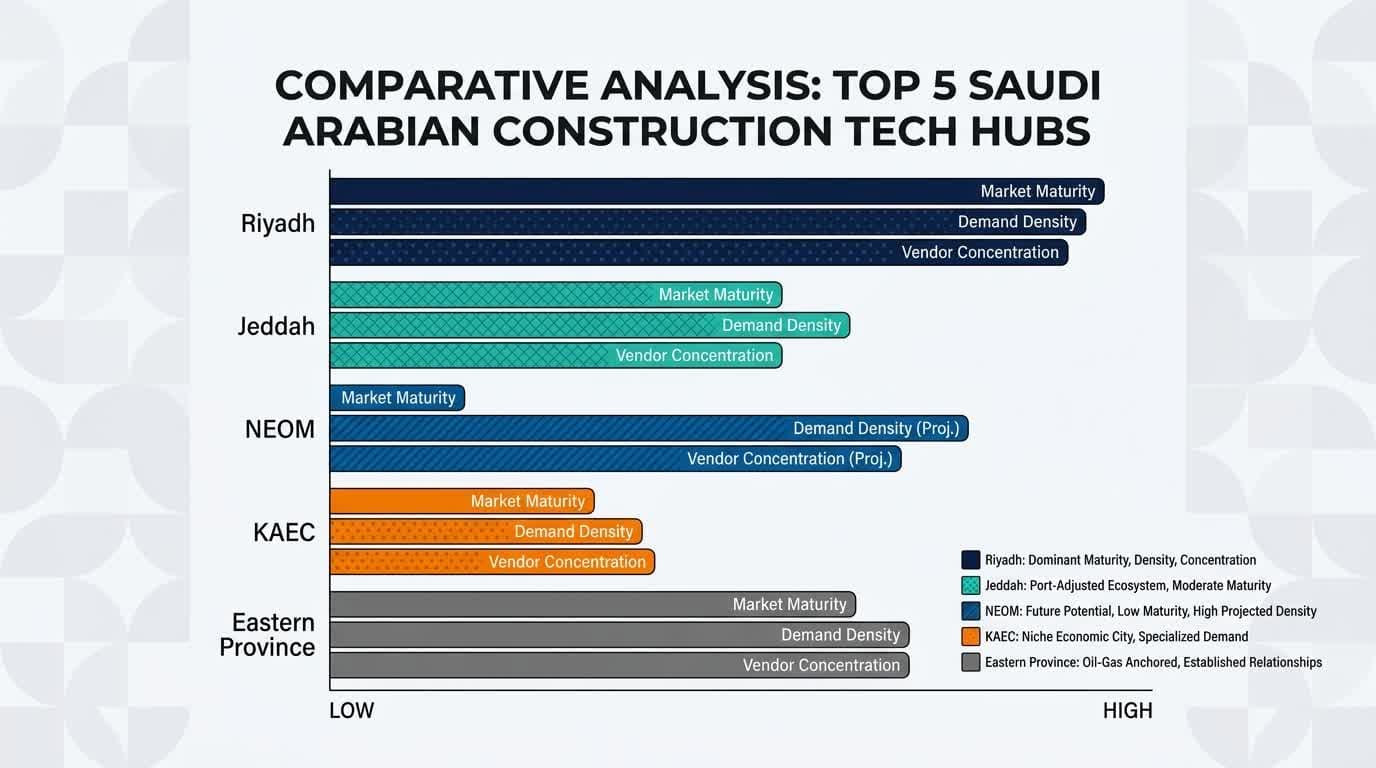
Saudi Arabia's software demand is highly concentrated within specific urban nodes rather than distributing evenly across the country's geography. Each metropolitan centre is shaped by distinct economic drivers, regional talent pools, and local regulatory environments. Consequently, overseas technology partners must evaluate these nodes as separate markets rather than interchangeable territories.
These city-specific markets represent entirely different strategic bets on the future of the Kingdom's digital landscape. Success depends on aligning specific software services with the unique commercial character and purchasing cycles of each location. A uniform national strategy often overlooks the profound operational variations between regions.
- Riyadh: Largest addressable market, deepest talent pool, government-linked procurement, and Vision 2030 spending hub.
- Jeddah: Red Sea port economy, informal networking culture, and logistics and trade facilitation focus.
- NEOM: Giga-project premium segment, smart-city infrastructure, and USD 120,000 to USD 180,000 engineering salaries.
- KAEC: Industrial and manufacturing focus, special economic zone, and operations-manufacturer buyer profile.
- Eastern Province: Aramco ecosystem, energy-sector IT demand, plus SCADA and industrial IoT specialisation.
Riyadh: the gravity well
Riyadh functions as the gravitational centre for both technology talent and government-linked procurement within the Kingdom. The capital hosts the King Abdullah Financial District, a purpose-built economic enclave that acts as a primary anchor for digital transformation spending across the banking and professional services sectors. This concentrated spending drives continuous demand for enterprise-grade architecture and robust data processing solutions.
Additionally, Riyadh Front offers specialised operational infrastructure for international firms seeking direct access to major public sector contracts. The concentration of large state-linked enterprises in the capital creates a complex procurement environment that historically prioritises established system integrators. Foreign providers entering this space must navigate formal, multi-stage tendering processes that require substantial local administrative support.
For foreign software developers, the capital offers the largest addressable market, the deepest local talent pool, and direct exposure to public spending programmes. Senior software engineering roles in Riyadh command salaries ranging from USD 80,000 to USD 120,000, driven by intense competition among consultancies and state entities. Tech startups are increasingly migrating to the capital to secure access to venture capital and government procurement channels.
This concentration has established the city as the largest single geographic cluster of IT companies in Saudi Arabia. However, the sheer density of participants means that differentiation depends on deep domain expertise rather than generalist capabilities. Success in the capital demands a thorough understanding of local regulatory standards and direct engagement with regional decision-makers.
Jeddah: the port-adjusted ecosystem
Jeddah operates under significantly different structural conditions than the capital, heavily influenced by its historical status as the primary Red Sea port city. This legacy of international commercial exchange has fostered a tech ecosystem shaped by private enterprise, shipping, and family-owned conglomerates. While the city lacks the dense concentration of financial and governmental institutions found in Riyadh, it compensates with a flexible commercial culture and a high proportion of internationally oriented businesses.
The technology scene in Jeddah is smaller and less formally structured than that of the capital. Professional networking in the Western Province relies heavily on word-of-mouth recommendations and informal digital channels rather than structured industry associations. This relationship-driven environment presents unique entry barriers for external partners, requiring long-term trust-building before formal engagements commence.
On the other hand, the market is less saturated with global vendors, leaving room for specialised firms to address underserved niches. Jeddah-based enterprises and startups serve a diverse commercial base focused on logistics, trade facilitation, and light industrial applications. Consequently, procurement patterns here are highly pragmatic, prioritising immediate operational efficiencies over abstract transformation initiatives.
NEOM: the giga-project premium
NEOM represents a unique demand profile within the regional technology landscape, operating as a distinct city-state project in the northwestern Tabuk region. Supported by planned investments of up to USD 500 billion, it functions as both an unprecedented physical build and an advanced digital development platform. The project aims for net-zero carbon operations, which creates substantial demand for complex systems like IoT networks, digital twins, and autonomous infrastructure managers [9].
This massive development generates highly active recruitment cycles, with senior software engineering roles commanding salaries between USD 120,000 and USD 180,000. The market demands advanced technical standards and strict compliance with national data sovereignty laws. Technical partners must collaborate closely with licensed local entities to deploy solutions within this secure ecosystem.
The entry barriers are exceptionally high, requiring firms to demonstrate substantial technical capability and robust risk management. Academic research identifies NEOM and parallel giga-projects as the primary catalysts driving the post-2021 acceleration in overall Saudi software spend [9]. This premium environment offers immense opportunities for specialists capable of delivering highly resilient, integrated smart-city systems.
King Abdullah Economic City: the industrial complement
King Abdullah Economic City occupies a specialised industrial niche, situated along the Red Sea coast north of Jeddah. Unlike NEOM, KAEC is designed around physical manufacturing, commercial logistics, and port operations rather than consumer-facing smart-city services. The city operates as a special economic zone with its own regulatory frameworks, specifically targeting software applications in petrochemicals, supply chain management, and automated manufacturing.
Academic literature notes that both KAEC and NEOM navigate shared structural challenges regarding governance, social inclusivity, and identity preservation across Saudi smart city initiatives [8]. For software developers, KAEC offers focused opportunities in industrial enterprise resource planning systems and logistics optimisation platforms. However, the regional buyer profile skews heavily toward operational managers rather than executive technology officers, requiring highly pragmatic, performance-driven sales propositions.
Eastern Province: the Aramco ecosystem
The Eastern Province, encompassing Dammam, Khobar, and Dhahran, represents a distinct demand node shaped almost entirely by the energy sector and Saudi Aramco. Dhahran houses Aramco's global headquarters alongside the King Fahd University of Petroleum and Minerals, forming a highly technical cluster focused on industrial software and advanced cybersecurity. Meanwhile, Dammam and Khobar introduce commercial diversification with emerging fintech and logistics ventures linked to key shipping and rail corridors.
For software developers, this region offers a highly lucrative but highly specialised enterprise customer base. The procurement criteria here differ substantially from Riyadh's public-sector bids, prioritising deep domain knowledge in SCADA systems, industrial IoT, and operational technology security. Consequently, engineering talent in the Eastern Province commands a substantial premium due to the technical complexity of these industrial compliance frameworks.
Furthermore, vendor evaluation processes in this province are notoriously rigorous, heavily favouring teams with verified experience in heavy industry over generalist software agencies. The geographic proximity to Bahrain and the wider Arabian Gulf also fosters cross-border development opportunities. This commercial flow helps integrate local software operations with broader regional transport and financial networks.
Startup ecosystem support infrastructure
Beyond these primary enterprise hubs, the Kingdom has established a highly structured support system for technology startups that fuels its own demand for software development. Monsha'at, the General Authority for Small and Medium Enterprises, coordinates nationwide support programmes and early-stage growth policies. Its subsidiary, Jada, operates as a robust fund of funds, actively channelling capital into regional investment entities.
To support scaling enterprises, the Saudi Venture Capital Company provides strategic funding targeting critical growth-stage gaps. Additionally, accelerator initiatives such as Merama offer technical guidance and resources to assist founders in transitioning from concepts to viable products. This comprehensive support network represents a key driver of external software demand, as funded startups seek reliable partners to build their minimum viable products and initial platforms.
This growing ecosystem is crucial for professional development partners aiming to establish a footprint in the region. By helping early-stage founders deploy scalable software, external developers can build deep relationships within the Kingdom's emerging digital economy. This collaborative approach aligns perfectly with the long-term partnership models valued across the Saudi business community.
This regional analysis shows exactly where technology demand concentrates and how procurement criteria vary across different urban nodes. However, any city-specific expansion strategy must ultimately contend with the Kingdom-wide constraints that shape talent acquisition, cost structures, and overall delivery capacity.
The talent pool: Saudization, Nitaqat, and the developer-supply question
The Saudi labour market presents a highly demanding structural constraint in the Gulf for software companies. With a population of approximately 36 million, of which 62 percent are Saudi nationals and 38 percent are expatriates, the kingdom operates a deliberate policy architecture that makes nationality a central variable in hiring decisions. For any organisation seeking to build or scale a software operation in the region, the interplay between local hiring requirements, available talent supply, and wage expectations constitutes the defining operational challenge.
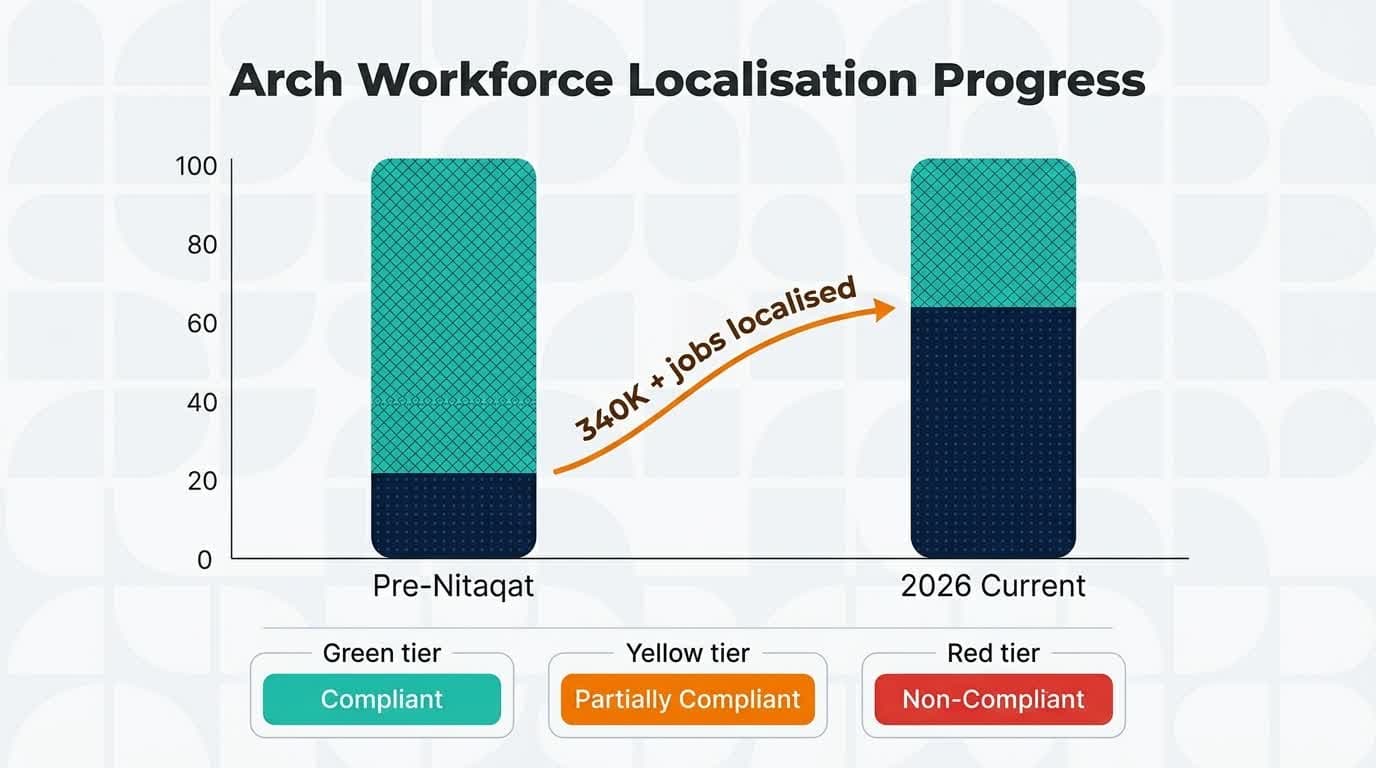
The Nitaqat programme is the primary instrument through which this dynamic operates. Introduced in 2011 and subsequently refined, Nitaqat classifies companies by colour bands based on their Saudi-national staffing ratio relative to sector-specific quotas. This classification directly dictates a firm's operational capabilities within the domestic market.
A company's assigned band determines its eligibility for visa issuance, contract renewals, and expansion permissions. This system creates a direct link between workforce composition and business continuity, shifting Saudisation compliance from a minor human resources task to a core board-level priority [15].
The Platinum and Green bands represent the compliant tiers of the Nitaqat framework. Platinum status is awarded to organisations with high rates of national employment, granting them preferential access to government contracts and rapid visa facilitation. The Green band signifies standard compliance, allowing firms to maintain normal operations and renew expatriate work permits without additional bureaucratic friction.
Conversely, falling into the Yellow or Red bands carries severe operational consequences for non-compliant companies. Yellow-banded firms face immediate restrictions, including a freeze on new visa issuances and a prohibition on expanding operations. Red status represents critical non-compliance, resulting in severe penalties such as the block on permit renewals and the potential loss of the corporate licence.
The regulatory environment continues to tighten as the state accelerates its localisation agenda. The next phase of the Nitaqat framework, extending from 2026 to 2028, aims to localise more than 340,000 jobs across the national economy [10]. For engineering and software development businesses employing five or more engineers, a strict Saudisation rate of 30 percent applies [10].
This regulatory shift means the pool of eligible expatriate hires is shrinking precisely as the demand for technical talent reaches record levels. Real-world accounts from Riyadh-based startups highlight this pressure, with many explicitly restricting junior roles to Saudi nationals to maintain compliance. Under the current regime, junior-level positions have become particularly difficult for foreign nationals to secure.
Academic research on Nitaqat outlines four core objectives, namely raising domestic employment, increasing firm efficiency, reducing foreign labour reliance, and formalising the wider market [11]. A detailed quasi-experimental study confirmed that the system successfully increased the Saudi share of employment, particularly within small and medium-sized enterprises [12]. However, the data also revealed measurable negative effects on firm survival within certain size cohorts, illustrating the substantial adjustment costs imposed by mandatory quotas [12].
These regulatory pressures are compounded by structural supply-side challenges within the local market. Empirical research highlights persistent barriers to localisation, including regional qualification gaps and high private-sector wage expectations [13]. Additionally, a historical reluctance to accept entry-level roles and differences in corporate work-culture remain significant hurdles for employers [13].
Consequently, artificially raising a company's Saudisation metric does not automatically guarantee an increase in operational productivity. Mandatory quotas often satisfy basic compliance metrics while leaving the underlying technical talent shortage unresolved [13].
To address these structural shortages, the kingdom relies on several key academic institutions tasked with cultivating the next generation of technical talent. King Fahd University of Petroleum and Minerals (KFUPM) and King Abdullah University of Science and Technology (KAUST) lead this educational effort, producing highly capable research graduates. King Saud University (KSU), Prince Sultan University (PSU), and research hubs like the King Abdulaziz City for Science and Technology (KACST) further bolster this domestic pipeline.
Under Vision 2030, the state has actively prioritised female participation in the workforce, unlocking a substantial and previously underutilised talent channel. While this female engineering pipeline is growing rapidly, it remains in a nascent stage relative to the overwhelming market demand. Furthermore, many Saudi graduates still prefer the stability of public-sector roles over private IT entities, creating notable retention challenges for private firms once training is complete.
Compensation patterns reflect this competitive landscape, with industry salary surveys indicating that mid-level software engineers in private firms typically command between USD 2,500 and USD 3,500 per month. Naturally, multinational corporations and government-backed entities offer significantly higher packages, drawing top-tier talent away from smaller enterprises. To navigate these resource constraints, many organisations rely on international system integrators such as Wipro, TCS, and Infosys.
These multinational firms frequently deploy their own pre-assembled technical teams to deliver large-scale projects. This outsourcing strategy allows businesses to make rapid progress on key initiatives while avoiding the immediate administrative complexities of direct expatriate recruitment.
Administrative hurdles, particularly visa processing timelines, present another significant friction point for growing companies. Securing work permits for skilled expatriates can take several months, often leaving critical projects exposed to resource gaps during peak development phases. This delay is compounded by a highly competitive local market, where counter-offers are frequent and talent retention remains an ongoing challenge.
To build sustainable development pipelines, forward-thinking organisations are adopting hybrid resourcing models that combine domestic compliance with global capacity. By maintaining a highly trained, core domestic team in Riyadh to satisfy Saudisation requirements, companies can secure their regulatory standing. They then scale their engineering output by partnering with nearshore or international development squads, ensuring delivery speed and cost efficiency without compromising compliance.
Ultimately, these talent constraints dictate the structural architecture, timeline, and overall cost of software delivery in the kingdom. Any successful digital strategy must account for the financial and operational realities of local hiring from day one. The critical question for foreign founders is how to navigate this landscape, establish a legal footprint, and plan for long-term compliance.
Market entry for foreign founders: setup, licensing, free zones, Saudisation planning
Foreign software companies entering Saudi Arabia navigate a substantially liberalised regulatory landscape compared to previous decades. The most consequential shift is the confirmation that international founders can now own 100 per cent of the shareholdings in their Saudi entity across technical sectors. This structural update eliminates the historical requirement for a local partner or sponsor.
The modern setup process involves registering directly with the Ministry of Commerce and obtaining relevant operational licences. Peer discussions among international founders confirm that setup is increasingly direct, bypassing older proxy structures.
The primary regulatory gateway for international capital is the Ministry of Investment (MISA). This central authority remains responsible for corporate licensing, investment facilitation, and ongoing administrative support. For international technology founders, obtaining a MISA licence provides a direct route to operating independently.
This structure represents a major departure from the legacy equity restrictions that once governed commercial entry into the Gulf region. The formal application process requires submitting a comprehensive business plan alongside capital verification and sector-specific documentation. Dedicated investor liaison officers are assigned to guide qualifying projects through the administrative pipeline.
While processing timelines fluctuate, the system offers high transparency for foreign engineering teams. Organisations seeking local app development in Saudi Arabia or KSA web development capabilities should treat MISA licensing as an essential strategic prerequisite.
Free zone options for foreign software companies:
- King Abdullah Economic City (KAEC): This is a purpose-built economic environment designed to streamline company formation for international investors, offering particular strength in manufacturing and logistics-adjacent services.
- Riyadh Front: This hub provides an integrated entry point for organisations prioritising proximity to the capital, serving as a primary gateway for firms targeting government contracts and financial institutions.
- NEOM: This region functions as a strategic platform for companies aligned with the Vision 2030 megaproject portfolio, particularly those operating in smart city infrastructure and AI-driven urban services.
Each of these special economic zones carries distinct licensing pathways, cost structures, and operational parameters. Choosing between a free zone registration and a mainland corporate structure directly affects tax positioning, import duties, and eligibility for public procurement contracts.
The Saudisation framework introduces a fundamental compliance requirement for any international firm establishing an in-Kingdom presence. Under the Nitaqat programme, the Ministry of Human Resources and Social Development categorises organisations by size and industry to mandate specific domestic hiring ratios. For technology companies, constructing a localised workforce is a critical legal obligation with direct consequences for ongoing visa approvals.
Founders must integrate these Nitaqat targets into their initial workforce models rather than treating them as optional milestones. The regulatory spectrum ranges from platinum and green bands down to non-compliant yellow and red categories. Maintaining a platinum or green status ensures preferential access to public procurement panels and streamlined employee visa processing.
For an incoming software firm, balancing these quotas against senior engineering requirements demands a structured recruitment architecture. Successful entrants typically address this by pairing senior international specialists with structured training initiatives for Saudi engineering graduates.
Data residency requirements introduce specific architectural considerations for engineering teams managing public sector or enterprise accounts. The launch of localised cloud infrastructure, including major data centres in Riyadh, underscores a state-level commitment to data sovereignty [16].
The AWS me-central-1 region provides a compliant hosting environment for platforms bound by national localisation policies [16]. For international firms accustomed to unrestricted cross-border data flows, these mandates require deliberate backend planning rather than simple storage adjustments.
Cloud systems in the Kingdom are governed by the strict regulatory frameworks of the Communications, Space and Technology Commission (CST) and the Saudi Data and AI Authority (SDAIA). Enterprise clients and government entities regularly require documented proof of local data residency prior to any contract signature.
Major global providers, including AWS, Microsoft Azure, and Oracle, have established in-Kingdom data regions to support this demand. For international firms deploying software-as-a-service platforms, routing sensitive data through compliant regional infrastructure is a fundamental commercial prerequisite.
Product localisation presents another strategic layer that operates alongside technical compliance. Designing interfaces with an Arabic-first layout is highly recommended for consumer-facing platforms and public services. International technology partners must treat right-to-left layout adaptation and local content alignment as baseline customer expectations rather than optional features.
What does software development cost in Saudi Arabia? A project pricing guide
Analysing app development costs and their primary drivers is vital for any organisation planning a digital initiative in the region. While search query metrics define market interest and salary scales indicate baseline overheads, neither element alone defines a practical deployment budget.
This section provides a realistic bridge between general market data and procurement reality. It translates underlying economic indicators into practical budget expectations for technology decision-makers.
Market evidence from regional vendors provides helpful reference points that procurement teams can use as initial budgetary anchors. Simple applications with straightforward features typically require an investment ranging from SAR 15,000 to SAR 50,000. Mid-range bespoke platforms incorporating backend databases and basic localisation generally scale from SAR 50,000 to SAR 150,000.
For complex enterprise systems featuring ERP integration, data residency compliance, and comprehensive Arabic-first user experiences, budgets routinely exceed SAR 150,000. These figures represent general market indicators rather than direct service quotes from Arch, serving purely as orientation guides.
The final budget for any digital product remains highly dependent on scope definition, deployment methods, and the selected engagement structure. Procurement teams must establish clear product requirements early to prevent unexpected variations in downstream execution costs.
Beyond general project complexity and feature volume, three specific factors shape software pricing within the Kingdom. Firstly, the financial impact of Saudisation quotas means that maintaining compliant domestic staffing ratios introduces structural overheads that are reflected in vendor fees.
Secondly, delivering high-quality Arabic-first products requires comprehensive right-to-left layout engineering, cultural translation, and native linguistic review. This localisation process requires specialist expertise and naturally increases the required development effort.
Finally, data residency compliance necessitates in-Kingdom cloud hosting and strict security configurations aligned with national regulatory standards. These requirements introduce additional architectural complexity and hosting overheads compared to standard global deployments.
The local IT market supports several engagement models designed to balance risk and budget. A Fixed Price structure transfers scope risk to the vendor, making it ideal for highly specified projects with clear boundaries. Alternatively, a Time and Materials approach offers flexibility as requirements evolve, though it demands disciplined oversight from the client.
For long-term initiatives, a Dedicated Team model allocates engineering resources to work directly under the buyer's product management. Another option is the Build-Operate-Transfer model, where an external partner establishes a team in the region before handing ownership over to the client.
Each framework carries unique cost implications and administrative profiles. The choice depends on technical certainty, project scale, and the client's planned operational longevity in the Kingdom.
Local software agencies often present lower initial estimates than international firms, although this price gap closes as structural complexity grows. Well-established international partners bring structured delivery pipelines and rigorous quality assurance protocols, which carry a premium reflecting their reliability.
When comparing quotes, sophisticated buyers focus on total risk-adjusted value rather than the raw hourly rate. Choosing a vendor solely on price often introduces severe downstream correction costs if the initial deployment fails to meet regulatory or performance standards.
Software procurement within regulated industries must account for several major compliance frameworks before any contracts are signed. The Communications, Space and Technology Commission (CST) mandates strict registration protocols for technology infrastructure. Meanwhile, the Saudi Data and AI Authority (SDAIA) oversees the usage of algorithms and data management practices.
For products handling financial transactions or payment data, strict compliance with the Saudi Central Bank (SAMA) is mandatory. Additionally, the National Cybersecurity Authority (NCA) establishes critical defense baselines for software operating near public infrastructure.
Finally, the Personal Data Protection Law (PDPL), enacted via Royal Decree M/19 of 2021, outlines clear rules for handling the personal information of Saudi residents. Procurement teams should verify that prospective vendors understand these regulatory expectations during the initial vetting phase.
Conclusion: KSA Software Market Intelligence
The most important characteristic of the Saudi technology sector is not its rapid expansion. It is the distinct gap between growing buyer demand and the informative content infrastructure needed to guide procurement decisions.
Across 43,850 monthly buyer intent signals spanning 202 demand segments, the evidence shows a landscape where subscription-based directories dominate the discovery layer while empirical analysis remains scarce [1][2]. The web development sector represents the largest segment with 12,000 monthly searches, reflecting a buyer base that continues to weigh custom infrastructure against packaged platforms.
Meanwhile, the app development segment exhibits a low competitive intensity of 8.9, yet offshore networks have claimed search prominence via directory profiles rather than local expertise [4][5]. This structural vacuum presents a major opportunity for firms that publish with objective, analytical authority.
The vendor landscape is structured in distinct tiers that reward informed buyers while penalising those who rely solely on aggregator lists. While global directory platforms resolve initial discovery challenges, their commercial models prioritise sponsored listings over client outcomes [4].
The system integrator tier, comprising multinational firms, operates on highly formalised global frameworks rather than individual developer evaluations [14]. Conversely, domestic agencies offer strong regulatory alignment but often face constraints in project management maturity, while international partners provide standardised methodologies that require rigorous verification [14].
Navigating these structural dynamics requires careful operational planning. For instance, the Nitaqat programme mandates specific workforce ratios that must shape corporate hiring from the very beginning [10][11][12].
Furthermore, the geographic division of demand across Riyadh, Jeddah, NEOM, KAEC, and the Eastern Province requires targeted strategies for each municipality [8][9]. Technical teams must also incorporate data residency protocols and Arabic-first user experiences into their core product architectures from day one [16].
Fortunately, the regulatory pathway for international entry has improved significantly. The availability of 100 per cent foreign ownership through MISA licensing eliminates the traditional sponsor requirements that once complicated entry into the GCC [15].
For technology leadership teams assessing the region, the evidence confirms that the commercial opportunity is highly accessible. Firms that approach this market with delivery discipline are well positioned to capture the enterprise demand currently mediated by online directories.
Arch's software development services are structured for environments where empirical planning and architectural reliability are the primary differentiators. For organisations seeking a technical partner with global delivery standards, further details are available via our main platform Learn more about Arch.
FAQs
Can a foreign technology company be in full legal possession of its entity in Saudi Arabia?
Yes, international software and IT companies can establish 100 per cent ownership of their local entities through the Ministry of Investment (MISA). This updated framework removes the historical requirement for a local partner or sponsor. The process requires obtaining a MISA investment licence and registering with the Ministry of Commerce.
Where must software companies host data to comply with Saudi laws?
To comply with local data sovereignty regulations, software systems handling national or personal data must use in-Kingdom data centres. Regulators like the Saudi Data and AI Authority (SDAIA) and the Communications, Space and Technology Commission (CST) enforce these residency rules. Major providers including AWS, Microsoft Azure, and Oracle offer compliant local hosting regions.
How much does it cost to build a mobile application in Saudi Arabia?
While actual development costs depend on project scope, general market indicators suggest that simple mobile applications range from SAR 15,000 to SAR 50,000. Mid-range custom builds featuring API integrations typically cost between SAR 50,000 and SAR 150,000. Enterprise-grade platforms requiring SAMA or CST compliance routinely scale beyond SAR 150,000 due to technical complexity.
What are the Nitaqat Saudisation requirements for software and engineering companies?
The Nitaqat programme classifies companies by colour bands based on their Saudi-national staffing ratio to determine visa eligibility and expansion. Specifically, engineering firms employing at least five engineers must reach a 30% Saudi-national staffing ratio starting from July 2025. Additionally, the next phase of Nitaqat from 2026 to 2028 aims to localise more than 340,000 jobs across the Saudi economy.
How is software demand geographically distributed across Saudi cities?
Software demand is concentrated in distinct urban nodes, led by Riyadh as the primary hub for government-linked procurement and Vision 2030 spending. Jeddah serves a port-adjusted ecosystem focused on logistics and trade, while NEOM represents a premium smart city segment driving specialized digital infrastructure demand. Other key areas include King Abdullah Economic City (KAEC) for industrial software and the Eastern Province for energy-sector IT driven by Aramco.
What are the primary cost drivers for software projects in Saudi Arabia?
Beyond basic feature complexity, the primary regional cost drivers are Saudisation hiring overhead, Arabic-first interface localisation, and strict data residency compliance. Meeting the mandatory 30% Saudi staffing requirement adds non-trivial workforce expenses that vendors factor into project pricing. Additionally, hosting sensitive data on compliant, in-kingdom cloud infrastructure and designing right-to-left Arabic layouts further scale development costs.
How do I evaluate vendors in Saudi Arabia?
Evaluating vendors in the Kingdom requires moving beyond the basic discovery layer that global aggregator platforms provide. These directories are frequently distorted by sponsored placements and pay-for-position models rather than objective technical capability. Consequently, relying on simple directory rankings often obscures the actual delivery capacity of local engineering teams.
A vital assessment metric is the precise ratio of permanent, in-house engineers to subcontracted or outsourced labour. Many regional firms operate as corporate body shops, securing contracts first and subsequently backfilling technical roles with unvetted contract resources. True engineering capability is verified by directly auditing the vendor's core developer payroll and retention rates.
The Saudi market remains heavily concentrated around state-backed entities and large corporate IT departments. Vendors with established project references for organisations such as Aramco, STC, or SABIC hold structural advantages that are exceptionally difficult for new market entrants to replicate. For enterprise buyers, this institutional navigation capability is often far more critical than individual developer CVs.
The evaluation calculus for global system integrators diverges significantly from mid-market software procurement. Rather than reviewing specific local developer credentials, buyers should assess the integrator's international delivery infrastructure and regional governance frameworks. This approach mitigates the risk of local resource constraints during critical implementation phases.
To bypass marketing-led representations, buyers should execute a structured technical audit prior to formal engagement. This clinical review isolates actual engineering maturity from corporate positioning:
- Core Payroll Audit: Verify the exact proportion of full-time, in-house developers versus temporary contract staff allocated to the project.
- Version Control History: Request anonymised repository samples or deployment logs to evaluate real-world code quality, branching strategies, and testing automation.
- Regulatory Architecture Alignment: Review previous builds for compliance with local frameworks, specifically assessing how data-at-rest matches the requirements of the Personal Data Protection Law.
- Reference Verification: Conduct direct, off-list reference calls with technical stakeholders at comparable regional or global organisations.
- Delivery Methodology Verification: Inspect active dashboard environments to evaluate sprint velocity and real-world deployment frequencies.
What is Nitaqat and how does it affect hiring?
Nitaqat represents the regulatory core of Saudi Arabia's Saudisation initiative, categorising organisations into colour-coded bands based on their proportion of domestic employees. These classifications, spanning Platinum, Green, Yellow, and Red, are calculated dynamically against sector-specific quotas and company size. A business unit's specific band directly dictates its operational capacity, influencing everything from visa issuance to corporate expansion approvals.
Under recent updates, engineering firms employing five or more specialists must maintain a minimum 30 percent domestic staffing ratio. This policy aligns with a broader macroeconomic phase targeting the localisation of more than 340,000 technical and administrative roles across the Kingdom. For foreign software firms entering the market, this regulatory environment is not a secondary HR consideration but a foundational architecture that must be addressed before recruitment begins.
Operating within the Platinum or Green bands unlocks critical privileges, including expedited visa processing and simplified corporate renewal procedures. Conversely, sliding into the Yellow or Red bands triggers immediate operational penalties that can compromise business continuity. Restricted enterprises face freezes on new work visas, blockages on internal role transfers, and an inability to renew existing employee contracts.
Navigating this framework requires international founders to adopt a balanced, hybrid staffing model. This strategy typically pairs a local core of Saudi engineers with highly integrated nearshore or offshore development squads. This approach satisfies regional compliance metrics whilst managing development costs and maintaining access to specialised technical talent.
What free zones are available for software companies in Saudi Arabia?
Three primary jurisdictions exist for foreign software companies looking to establish a regional presence. King Abdullah Economic City (KAEC) offers a purpose-built environment with specialised strength in manufacturing and logistics-adjacent services. Riyadh Front provides direct proximity to the capital's corporate ecosystem and public procurement pipelines.
NEOM functions as a strategic platform for organisations aligned with the Vision 2030 megaproject portfolio, particularly those focusing on smart city infrastructure, renewable energy software, and AI-driven services. Each zone carries distinct licensing pathways, administrative fees, and operational flexibilities. Choosing between free zone registration and mainland company formation carries long-term implications for VAT registration, customs duties, and direct access to government contracts.
What is the current size of the Saudi software market?
Five thousand buyers search for Saudi IT vendors every month, yet they find only empty aggregator lists. The real software market in Saudi Arabia is hidden behind regulatory gates, talent quotas, and regional geography.
This digital search volume is not mere curiosity; it represents a profound migration of B2B procurement behaviours. Across 202 unique search terms, a combined monthly volume of 43,850 addressable queries serves as a direct proxy for real-world economic demand as buyers bypass traditional offline tenders in favour of early-stage digital discovery.
This digital interest matches the massive capital investments shifting through the Kingdom. The Saudi Arabian software market was valued at USD 8.1 billion in 2025 and is projected to expand to USD 23.5 billion by 2034, registering a compound annual growth rate of 12.57 per cent. Within this broader category, enterprise-specific applications command a valuation of USD 3.53 billion in 2025, with projections positioning it to reach USD 10.38 billion by 2033.
Mobile app development represents a significant subset, sitting at USD 2.2 billion in 2025 and climbing to USD 5.7 billion by 2033 at an annual growth rate of 11.20 per cent. Supporting this software layer is an aggressive expansion of local infrastructure, with domestic data centre capacity on a trajectory to grow at 29 per cent annually through 2030. This infrastructure surge ensures that data-residency mandates can be met locally, laying the physical foundations for enterprise-grade deployments.
These systemic investments have propelled public-sector digital maturity to global standards, as evidenced by Saudi Arabia achieving a UN E-Government Development Index score of 0.9602 in 2024. These highly mature structural conditions generate continuous, complex integration requirements for software vendors across government ministries, large-scale enterprises, and scaling business segments.
Can foreign software companies own 100 percent of their Saudi entity?
International technology firms can now establish and maintain absolute control over their operations in the Kingdom without local intermediation. Under current regulations, foreign investors are permitted to own 100 percent of the shareholdings in their Saudi entity across the consulting, software, and IT services sectors. This structural shift has dismantled the historical partner-sponsor requirements that previously governed entry into the wider Gulf Cooperation Council market.
The Ministry of Investment of Saudi Arabia (MISA) serves as the primary regulator and facilitator for international businesses seeking to enter the domestic market. Obtaining a MISA investment licence represents the critical initial gateway, enabling foreign entities to operate legally under the Foreign Investment Law. This licensing path streamlines the administrative journey, allowing direct coordination with the Ministry of Commerce for subsequent corporate registration.
Operating as a fully foreign-owned entity requires strict compliance with domestic regulatory frameworks and data protection standards. Technology companies must navigate the Personal Data Protection Law (PDPL), which dictates stringent protocols for local data residency and processing. Additionally, systems hosting digital assets must align with the cloud computing classifications set by the Communications, Space and Technology Commission (CST).
Establishing a local presence also triggers immediate requirements under the national Saudisation framework, known as the Nitaqat programme. Companies are placed into colour-coded bands based on their ratio of national employees, directly impacting their ability to secure new work visas. Founders and engineering leaders must therefore balance complete corporate ownership with a structured, compliant approach to local recruitment and talent development.
Research methodology
This publication bases its market analysis on the tracking of 43,850 monthly buyer intent signals across 202 unique demand segments in the Saudi software market. These signals are synthesized with comparative market-size projections from independent analyst groups, specifically IMARC Group, Grand View Research, and Technavio. This framework allows for a rigorous assessment of transactional readiness and demand volume across the Kingdom's evolving digital landscape.
The research criteria segment the broader IT sector into distinct growth profiles, focusing heavily on enterprise software, web development, and mobile app development. Additionally, the analytical scope evaluates localized demand patterns and talent distribution across five primary geographic nodes, which are Riyadh, Jeddah, NEOM, King Abdullah Economic City, and the Eastern Province. By cross-referencing regional salary distributions with operational constraints, the analysis establishes clear benchmarks for domestic and international software delivery.
The methodology integrates structural policy assessments, focusing on the Nitaqat Saudisation programme's colour bands and its direct impacts on workforce composition. These regulatory factors are examined alongside academic literature regarding localization barriers and Agile adoption trends in Saudi small and medium-sized software enterprises. Finally, the research incorporates compliance mandates from governing authorities including the Saudi Data and AI Authority (SDAIA), the Ministry of Communications and Information Technology (MCIT), and the Communications, Space and Technology Commission (CST).
About the Author
Hamish Kerry is the Marketing Manager at Arch, where he specializes in translating complex technical capabilities into pragmatic, outcome-led strategies for digital products. With deep expertise in mobile framework analysis and emerging technologies, he guides technical decision-makers and startup founders through critical architecture and positioning decisions. His approach prioritizes empirical data and user-centred design over speculative industry trends.
At Arch, Hamish champions an accessibility-first methodology that aligns real-world business impact with measurable end-user value. He works collaboratively with engineering and product teams to dismantle transactional sales talk in favor of evidence-based market analysis. Through rigorous evaluation of evolving software landscapes, he provides clear, actionable pathways for sustainable product growth.
References
1. IMARC Group — *Saudi Arabia Software Market (USD 8.1B 2025 to USD 23.5B 2034, 12.57% CAGR)*. Available at: imarcgroup.com
2. Grand View Research — *Saudi Arabia Software Market (USD 10,071.8M 2024 to USD 22,748.2M 2030)*. Available at: grandviewresearch.com
3. Technavio — *Saudi Arabia IT Market (CAGR 7.0% for 2026-2030)*. Available at: technavio.com
4. Clutch — *Offshore App Development Agency Profiles*. Available at: clutch.co
5. Altuwaijri, F.S. (2022) — *Factors affecting Agile adoption: An industry research study of the mobile app sector in Saudi Arabia*. Journal of Systems and Software. Available at: doi.org/10.1016/j.jss.2022.111347
6. Roland Berger — *Unlocking the Data Center Opportunity in KSA*. Available at: rolandberger.com
7. UN E-Government Development Index — *Saudi Arabia E-Government Index Score (2024)*. Available at: un.org
8. University of Jeddah / Lumen Publishing — *Smart city challenges (NEOM and KAEC shared vulnerabilities)*. Available at: lumenpublishing.com
9. MDPI — *NEOM case study: post-2021 acceleration in Saudi software spend*. Available at: mdpi.com
10. AHYSP — *Nitaqat Saudization Programme new phase 2026-2028*. Available at: ahysp.com
11. Harvard CID Working Paper 132 — *First wave Nitaqat (2011-2013) success in raising national employment*. Available at: harvard.edu
12. Harvard CID Working Paper 381 — *Nitaqat effects on firm survival and SME heterogeneity*. Available at: harvard.edu
13. White Rose / IJOA — *Localisation barriers and qualification gaps in Saudi private sector*. Available at: whiterose.ac.uk
14. Academia.edu — *National ERP vendors in government organisations: a case of Saudi Arabia*. Available at: academia.edu
15. AEA — *Nitaqat programme structure and colour banding system*. Available at: aeaweb.org
16. AWS — *KSA infrastructure region (data residency and cloud compliance)*. Available at: amazon.com